
statism /stā′tĭz″əm/ noun
The practice or doctrine of giving a centralized government control over economic planning and policy..
The belief that the centralization of power in a state is the ideal or best way to organize humanity
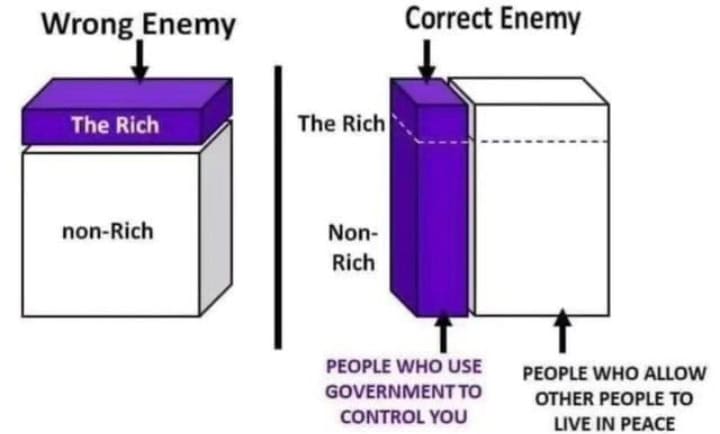
The picture above draws a line that money does not.
On the left, the supposed enemy is a thin layer of rich people sitting on top of everyone else. On the right, the cut runs the other way. A thin slice of both rich and non-rich people wants to use government to run other people’s lives. The rest, again both rich and non-rich, mostly want to be left alone.
That second cut is the one that matters.
Treating “the rich” as the enemy is tidy, and it is wrong. Wealth is not a moral category. Some rich people got there by building something other people chose to buy. Some got there by getting the law written in their favor. Some poor people work, trade, and mind their own business. Some want rules that tell strangers how to live, what to charge, whom to hire, and what they may say. Income does not sort those groups. Behavior does.
The useful question is not “how much does this person have?” It is “does this person want force used on peaceful people?” Government is the institution that can tax, fine, license, ban, and jail. Anyone who reaches for that machinery to make others conform is on one side of the picture, whether they live in a mansion or a rented room. Anyone who is willing to let other adults live, trade, speak, and associate in peace is on the other side, again regardless of bank balance.
That is why the left-hand cube misleads. It paints the whole top layer purple and calls it the problem. In real life the top layer is mixed, and so is the bottom. A landlord who lobbies for rules that shut out competitors is using government to control you. So is a voter who wants the state to set wages, prices, speech rules, or medical choices for people who never agreed. A rich founder who sells a product and stays out of politics is closer, on this axis, to a poor neighbor who does the same than either is to the lobbyist or the busybody.
The right-hand picture also explains why rich-versus-poor politics keeps disappointing people. If the fight is framed as a class war, the prize is control of the state. Whoever wins then uses that control on the losers. The winners may be rich donors, party machines, agencies, or organized voting blocs. The losers are everyone who wanted to be left alone. Transferring money or writing new rules does not remove the habit of control. It only changes who holds the pen.
None of this says wealth never comes with unfair advantage, or that fraud, theft, and genuine monopoly should be ignored. Those are wrong because they coerce or deceive, not because the culprit’s account is large. A poor fraudster and a rich fraudster belong in the same narrow slice. A rich person who earns by consent and a poor person who does the same belong in the wide one.
Plainly: the enemy is not a tax bracket. It is the willingness to make other people live by your plan, backed by law. The alternative is not chaos. It is the older rule that adults may do as they like so long as they leave other people in peace. That rule does not care how much money anyone has. It only cares whether they mean to rule their neighbors or let them be.
– BrandX