
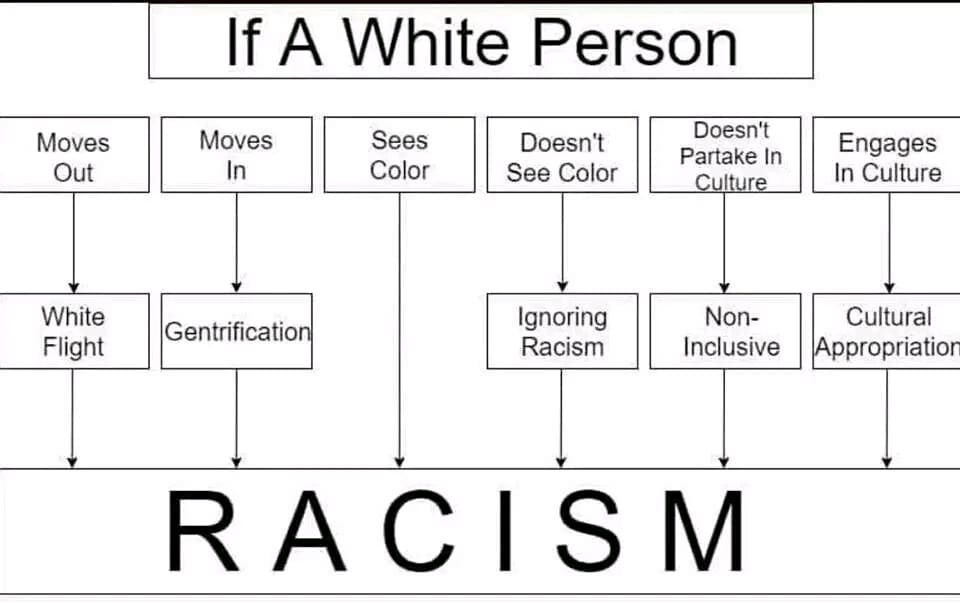
I have seen the above graph circulate on social media. It highlights much of the propaganda and divide and conquer that we really saw ramp up following 2012.
I say 2012, as this was the second-term election year for US President Obama. The first term (2009-2013) was about selling ‘Hope™’… the second was about selling “Woke” (the sacrilisation of historically disadvantaged race, gender and sexual minorities, led by a cultural revolution that seeks equity according to group identity by authoritarian means).
And don’t worry, as I write this in 2026, “Woke2™” (The Sequel!) is coming soon.
But back to the chart!
Here are documented examples matching each path on the flowchart, drawn from public statements, articles, books, and academic work by progressive/antiracism™ advocates. These illustrate the pattern of labeling ordinary residential, perceptual, or cultural choices by white people as forms of racism.
Moves Out → White Flight
Michelle Obama, speaking at the 2019 Obama Foundation Summit (and elaborating on her memoir *Becoming*), described white families leaving her Chicago South Side neighborhood as she and other Black families moved in: “As we moved in, white folks moved out because they were afraid of what our families represented… Y’all were running from us, and you’re still running.” She framed the moves as driven by racial fear over skin color and hair texture, rather than factors such as schools, crime, or property values, and equated it to current reactions to immigrants.
We see this in the UK in many towns such as Brierfield, Keighley, Luton or cities such as Bradford, even parts of London.
Moves In → Gentrification
Progressive outlets and scholars routinely cast white in-migration into urban neighborhoods as racist displacement. A 2017 article in *The Contra Costa Pulse* (“Gentrification Means More White People Moving In”) defines it as white people renovating areas to middle-class tastes, pushing out longtime minority residents, raising rents, and “colonizing” communities—leaving fewer people of color and non-local businesses. Academic work such as Zawadi Rucks-Ahidiana’s 2022 paper “Theorizing Gentrification as a Process of Racial Capitalism” and related analyses treat gentrification as inherently racialized white structural dominance, even when it involves economic upgrading.
Sees Color → Racism
Antiracism frameworks often treat race-consciousness itself as the correct stance, yet people are still accused of racism for “seeing color” in ways that do not fit equity narratives (e.g., noticing statistical group differences in crime, academic outcomes, or behavior without attributing them solely to systemic racism). Critics of color-blindness (including Ibram X. Kendi and Robin DiAngelo) argue that failing to center race appropriately perpetuates hierarchy, while race-aware observations outside the approved lens are dismissed as racist ideas. DiAngelo’s work, for instance, insists white people must see racial dynamics and their own positionality or remain complicit; deviations from that prescribed seeing are framed as upholding racism.
Doesn’t See Color → Ignoring Racism
Ibram X. Kendi writes in *How to Be an Antiracist* (2019): “The language of color blindness—like the language of ‘not racist’—is a mask to hide racism.” He and others argue that claiming not to see race prevents recognition of inequality and allows racism to persist. A 2015 *Guardian* op-ed by Zach Stafford states: “When you say you ‘don’t see race’, you’re ignoring racism, not helping to solve it… ‘Colorblindness’ doesn’t acknowledge the very real ways in which racism has existed and continues to exist.” Sociologist Eduardo Bonilla-Silva’s *Racism without Racists* and related work make the same core claim about “color-blind racism.”
Doesn’t Partake In Culture → Non-Inclusive
Diversity, equity, and inclusion literature and training often treat non-participation in multicultural events, homogeneous social circles, or a lack of active engagement with minority cultures as exclusionary or a failure of allyship. White people who do not diversify their interactions or “do the work” of cultural participation are described as reinforcing segregation or privilege through their choices (DiAngelo and others note that children’s racial attitudes track mothers’ interracial friendships more than stated beliefs). Organizational and campus practices frequently label monochromatic spaces or opting out of affinity/multicultural programming as non-inclusive by default, framing non-engagement as a barrier to equity.
Engages In Culture → Cultural Appropriation
Accusations of cultural appropriation are routine when white people adopt styles, foods, practices, or aesthetics associated with other groups. Common targets include cornrows or dreadlocks (Kim Kardashian, Bo Derek, and many others), yoga, ethnic cuisine prepared or sold by non-members of the originating culture, Native American headdresses in fashion (e.g., Victoria’s Secret runway), and Día de los Muertos aesthetics for Halloween. Activists, writers, and outlets produce articles, lectures, and social media campaigns defining such engagement as exploitation or erasure when done by outsiders, especially whites.
Summary
These examples come from high-profile figures, bestselling books, academic journals, and mainstream progressive media.
The flowchart captures a consistent rhetorical pattern: the same demographic is criticised for both exiting and entering neighborhoods, for both acknowledging and ignoring race, and for both engaging with and avoiding other cultures.
– BrandX